Climate Attribution Database Updates (Summer 2026)
The Sabin Center’s Climate Attribution Database contains hundreds of scientific and legal resources examining climate attribution science, its use in lawsuits addressing anthropogenic climate change, and impacts on human and natural systems. For information about this database, questions, or to alert the database managers to resources that merit inclusion, please contact [email protected] or submit a resource here.
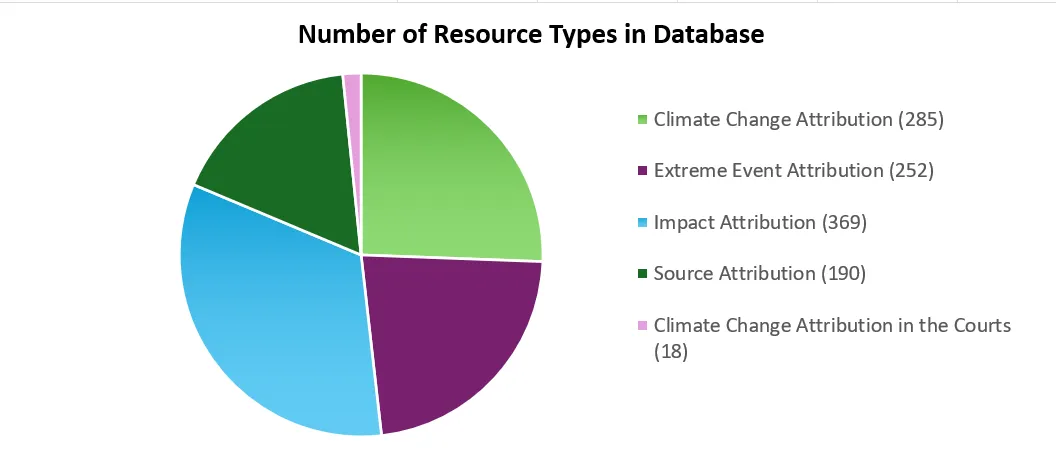
As of August 10, 2026, the Database contains 792 resources exploring climate change attribution under four categories of attribution: climate change attribution, extreme event attribution, impact attribution, and source attribution. Note that some resources are cross-listed between two or more categories. A fifth category, court attribution, lists testimonies and written reports of scientific experts filed in global legal proceedings that apply or review climate attribution science.
The Sabin Center compiles and maintains multiple databases and other resources—both on its own and in collaboration with other institutions—to facilitate access to the latest information, law, and scholarship on particular climate change-related topics. These resources are publicly available here. The Sabin Center’s latest updates on climate change litigation are available here.
Earlier this summer, the Sabin Center co-hosted the Second Conference on Attribution Science and Climate Law. With nearly 200 attendees, speakers, and moderators; over 100 virtual participants; and hundreds of views of the recordings, the conference was a wide success. Discussions ranged from understanding the state of attribution science, innovative discoveries, effects on health and displacement, and implications for legal action. A full synopsis of the conference is forthcoming.
FEATURED ATTRIBUTION DATABASE UPDATES
Below are featured updates to the attribution database over the last several months, identifying current prominent themes within climate attribution science and legal implications.
National Academies Extreme Event Attribution Report
In July 2026, the National Academies released a new report on Attribution of Extreme Weather and Climate Events and Their Impacts, which is a major update to its 2016 report on extreme event attribution (EEA). The 2026 report synthesizes the current state of EEA science and the emerging field of extreme event impact attribution, and finds that EEA has made substantial advances over the past decade, driven by improvements in scientific understanding, observational datasets, statistical methods, and climate modeling. The Report also evaluates remaining challenges with EEA science, discusses the varying degrees of scientific confidence across different areas of EEA, and provides recommendations for further advances in this field.
Attribution of Heatwaves and their Impacts
Extreme heatwaves across various countries and their impacts on human health and the environment have emerged as a main theme in recent additions to climate attribution science. Recent research demonstrates that these heatwaves are escalating rapidly in both intensity and frequency, with human-induced climate change serving as a major driver.
A study published in Advances in Climate Change Research in May 2026 quantified the effect of anthropogenic climate warming on the 2023 North China Heatwave. Model results indicated that anthropogenic warming contributed roughly 2.1 ºC to the heatwave intensity and resulted in a 91.2 mm precipitation deficit. Another study published in Weather and Climate Extremes in May 2026 focused on the effects of climate change on prolonged heatwaves in West, South, and Southeast Asia during the early-summer months of 2024. The research found that anthropogenic climate change had significantly increased the likelihood and intensity of these extreme heat events, e.g., the results indicated that anthropogenic warming had increased the intensity of one heatwave in the Philippines by ~ 1.2 ºC and that this heatwave would have been “virtually impossible” without climate change. While El Niño typically increases the baseline intensity of heatwaves in this region, this study emphasized that global warming now plays the dominant role in amplifying intensity and increasing likelihood of extreme heat events.
Such heat hazards have been shown to adversely affect vulnerable populations and increase human health risks. A study published in Weather and Climate Extremes in March 2026 revealed that anthropogenic climate change has increased children’s exposure risk to extreme heatwaves by approximately 55%. Prolonged heat exposure has been shown to reduce cognitive function and academic performance, with researchers warning that such sustained exposure can lead to a loss of up to 1.5 years of education per child. In the UK, another study published by the Grantham Institute in July 2026 found that unprecedented early-season heatwaves yielded the highest temperatures ever recorded for May 2026 in parts of England and Wales. The study also attributed about half of heatwave-related deaths to the additional heat caused by human-induced climate change. Out of the total deaths attributable to the extreme heat, climate change drove 327 (59%) of the excess deaths in May and 825 (38%) of the excess deaths in June.
Rising ocean temperatures have also emerged as a trend in heat attribution studies, driven primarily by long-term anthropogenic climate change. A study published in the Journal of Environmental Management in June 2026 found that the Mediterranean Sea has undergone rapid thermal intensification tied to global climate change. The rising baseline temperature paired with these marine heatwaves have caused heightened mortality rates of marine life. This poses a risk of destabilizing vulnerable ecosystems and jeopardizing coastal economies reliant on fisheries. Another study published in One Earth linked 40% of coastal continental heatwaves to rising oceanic temperatures. This research emphasizes that rising marine temperatures act as a prominent driver of increased heat exposure in heavily populated coastal areas, and simultaneously increase climate risks further inland.
Attribution of Declining Ecosystem Resilience to Climate Change
Declining grassland resilience across East Asia has been linked to human-induced climate change. In a July 2026 assessment of Chinese grasslands, published in Global and Planetary Change, researchers mapped changes in ecosystem stability in a 20-year study. Climate change reduced grassland resilience 8.39 times more than human activities like livestock grazing. Specifically, intensified precipitation variability was the dominant driver of resilience loss. Mongolia showed a similar trend: a study published in June 2026 in Agriculture, Ecosystems & Environment revealed that climate change impacts accounted for 90% of the changing vegetation dynamics, whereas grazing accounted for only 10%. The research suggests that changes in climate may affect regional ecosystem health more than local land-use choices.
On a broader scale across northern ecosystems, a study published in One Earth in April 2026 identified that severe seasonal reductions in vegetation growth were directly tied to concurrent climate extremes, such as severe droughts, heatwaves, and sudden cold snaps.
Attribution of Extreme Precipitation, and Its Impact
Much recent literature has focused on the causal link between extreme precipitation and human-induced climate change, as well as its impact on human health. A research article published in Atmospheric Science Letters in May 2026 highlighted the influence of anthropogenic factors on the global impact of increasingly common heavy precipitation events in Japan. According to the study, these factors impacted hourly extremes more than daily totals, indicating that short-term precipitation exhibits a higher sensitivity to global warming. Furthermore, in northern Japan, the probability of extreme rainfall has nearly doubled between the 1950s and 2010s. The study indicated that this reflects the combined effects of air and ocean warming, increasing atmospheric humidity.
Increases in extreme precipitation can adversely affect public health through multiple pathways, including direct exposure to floods, adverse impacts on water quality, and increase in vector borne diseases. A modeling study in One Earth in April 2026 in Peru revealed that extreme precipitation from Cyclone Yaku in 2023 directly caused 60% of the dengue cases reported over a span of three months. The study found that the extreme wet conditions that occurred in March 2023 were 31% more likely to occur in recent decades compared to the preindustrial era. Furthermore, the likelihood of these wet conditions co-occurring with warm temperatures suitable for the transmission of mosquito-borne illnesses increased by 189%.
Other Notable Additions to the Database
Below are a few other recent additions to the Database:
- Advancing Extreme Event Impact Attribution: Attributing Multi-hazard Impacts of Hurricane Ida in South Louisiana to Past, Present, and Future Climates
- Shifting Flood Regimes in Arctic Basins under Climate Change
- Approaches, Challenges and Applications of Climate Change Impact Attribution
- Detection and Attribution of the Role of Anthropogenic Climate Change in Industrial-Era Retreat of Pine Island Glacier
- Attribution of UK Temperature Changes to Anthropogenic and Natural Factors