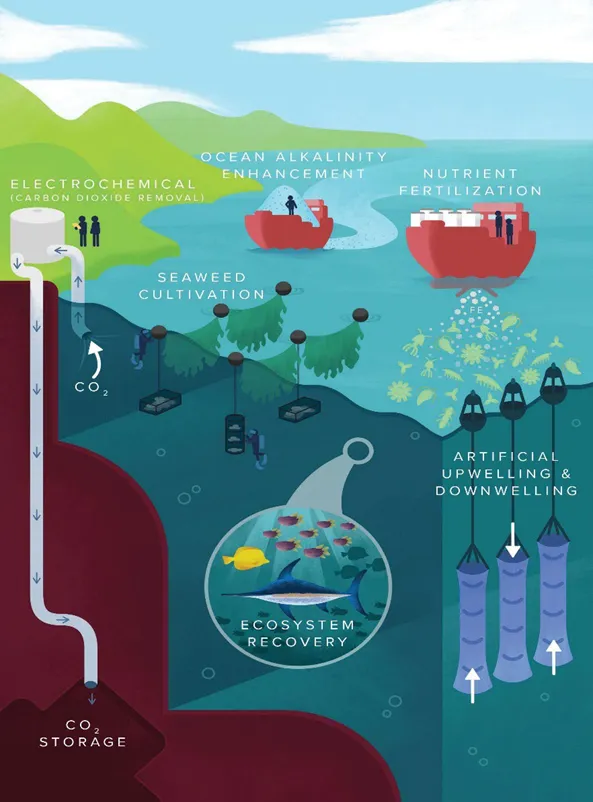
A new report from the National Academies of Sciences, Engineering, and Medicine finds that marine carbon dioxide removal (CDR) could play an important role in addressing climate change, but faces significant governance gaps that could limit its development and deployment. Sabin Center’s Deputy Director Romany Webb serves on the National Academies' Standing Committee that authored the report’s analysis of marine CDR governance.
The report was published today and updates two key sections of the 2022 report: (1) exploring a broad range of governance considerations for marine CDR, and (2) discussing the specific marine CDR technique of ocean alkalinity enhancement (OAE). The authors also published a new summary of the “State of Marine CDR,” which provides a broad overview of the current status, challenges, and opportunities of marine CDR.
The need for additional CDR is becoming increasingly urgent. The United Nations Environment Programme’s recent Limiting Overshoot report warns that global temperatures are likely to exceed 1.5°C above pre-industrial levels within the next decade and emphasizes the need to rapidly reduce emissions while scaling up carbon dioxide removal.
Marine CDR research has advanced significantly since the National Academies’ 2022 report, including through new ocean field trials. Private companies have also entered the field and begun selling marine CDR carbon credits, while governments and international bodies continue to develop regulatory approaches.
The new report concludes that “governance gaps directly constrain the near-term scalability of” OAE and calls for further work to advance marine CDR governance at the international, national, and subnational levels.
Marine CDR presents unique regulatory challenges because it involves deliberate interventions in the ocean, a global commons shared by all countries. Existing international agreements and national environmental laws may apply to some activities, but many were not specifically tailored for marine CDR, creating potential gaps and uncertainties.
The report emphasizes that governance frameworks should address these gaps and support responsible research and development while maintaining strong environmental and social safeguards.
Media Contacts: Romany Webb, Deputy Director, Sabin Center for Climate Change Law ([email protected]) and Tiffany Challe-Campiz, Communications Associate, Sabin Center for Climate Change Law ([email protected])