Climate Attribution Database Updates (Spring 2026)
The Climate Attribution Database is a thematically organized repository of scientific information relevant to climate litigation and policy-making. For information about this database, questions, or to alert the database managers to resources that merit inclusion, please contact [email protected] or submit a resource here.
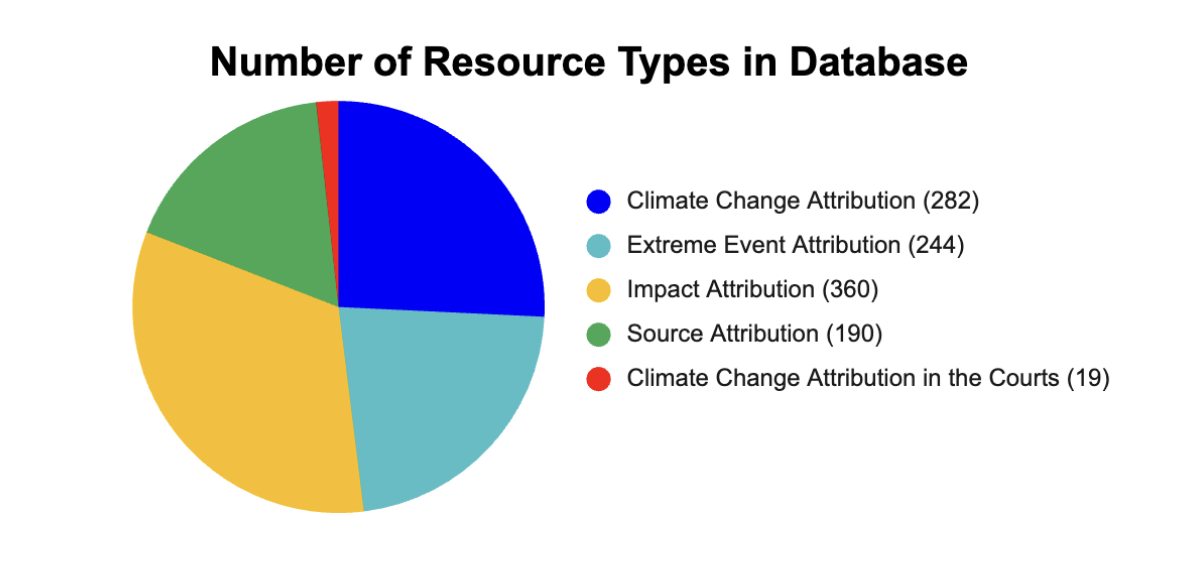
As of May 18, 2026, the Climate Attribution Database contains 777 resources that explore the links between anthropogenic climate change, impacts, and applicability to litigation. These resources are listed in five sometimes-overlapping categories: climate change attribution, extreme event attribution, impact attribution, source attribution, and “court attribution” (use of attribution science in the courts). The vast majority of resources in the database are peer-reviewed and published scientific studies; these studies, and additional reports, court declarations, and other resources in the database analyze climate impacts from all around the world at every scale, ranging from worldwide atmospheric impacts to those affecting a particular town, endangered species, or specific hazard risk.
ANNOUNCEMENTS
The Sabin Center is also pleased to announce that it is hosting the Second Conference on Attribution Science and Climate Law, along with the Columbia Climate School, on June 10-11, 2026 at the Bollinger Forum. This event will build on the success of a previous conference on this topic and will touch on many elements of our work in Climate Law and Science. The Conference is open to the public and will be livestreamed and recorded. More information and registration can be found here.
The Sabin Center compiles and maintains multiple databases and other resources—both on its own and in collaboration with other institutions—to facilitate access to the latest information, law, and scholarship on particular climate change-related topics. These resources are publicly available here. The Sabin Center’s latest updates on climate change litigation are available here.
FEATURED ATTRIBUTION DATABASE UPDATES
“Court Attribution” Category Added to Attribution Database
As noted above, the Climate Attribution Database now contains a “court attribution” category, which compiles attribution research presented in expert reports, declarations, and other court documents. This category was added to the database in Spring 2025. Court attribution documents can be found here.
Multnomah County, Oregon Uses Attribution Science in Lawsuit Against Major Fossil Fuel Companies Over Damages from 2021 Pacific Northwest “Heat Dome”
In June 2023, Multnomah County filed a lawsuit in Oregon Circuit Court against several fossil fuel companies, oil and gas industry trade associations, and the consulting company McKinsey and Company, Inc. (McKinsey), seeking to hold them liable for harms allegedly caused by anthropogenic climate change to which the defendants substantially contributed. County of Multnomah v. Exxon Mobil Corp., No. 23-CV-25164 (Or. Cir. Ct., filed June 22, 2023). Specifically, the lawsuit alleged that Defendants “knew that carbon pollution emitted by their products into the atmosphere would likely cause deadly extreme heat events like that which devastated Multnomah County in late June and early July 2021.” The County’s complaint relied on studies linking the extreme heat to Defendants’ emissions.
In April 2025, Multnomah County submitted declarations by climate scientists Dr. Daniel L. Swain, Ph.D. and Richard Heede in support of its lawsuit. The Heede Declaration identified emissions of carbon dioxide and methane from select fossil fuel companies from 1950 to 2022. The Swain Declaration assessed links between anthropogenic climate change, extreme heat in the Pacific Northwest, and specific emitters. Two months later, the County added a Declaration by Dr. Benjamin A. Franta, J.D., Ph.D., which addressed Defendants’ alleged historical misrepresentations regarding climate change and contributions to the heat dome.
The case is ongoing. Most recently, the Oregon Circuit Court issued an order in October 2025 discounting two scientific studies on climate change on which Plaintiffs rely, because Plaintiff’s counsel had failed to disclose a separate relationship with their publication.
New York State Relies on Climate Attribution Science to Support its 2024 Climate Superfund Act in Lawsuit with U.S. Federal Government
In May of 2025, the United States filed a lawsuit against the State of New York and relevant officers, challenging the state Climate Superfund Act, a 2024 New York law that seeks to hold fossil fuel companies liable for their contribution to climate change and its effects. United States v. New York, No. 1:25-cv-03656 (S.D.N.Y., filed May 1, 2025). The United States argued that the law was pre-empted by the Clean Air Act and the federal government's control over foreign affairs and that it would violate the Interstate Commerce and Foreign Commerce Clauses. The United States asked for declaratory and injunctive relief.
The United States filed an early motion for summary judgment in August of 2025, arguing in part that “the Superfund Act penalizes companies for greenhouse gas emissions without any certainty that those emissions caused in-state harm.” As part of their response in opposition, Defendants argued that particular harms caused by climate-change were in fact traceable to specific fossil fuel producers. In support of the response, defendants filed a declaration by climate scientist Dr. Justin S. Mankin, Ph.D. Dr. Mankin relied on climate attribution science in his declaration, explaining that there is a peer-reviewed consensus that “science can, with high degrees of confidence, trace state-level harms back to particular emissions, such as those originating with the production and sale of fossil fuels made by individual companies.” He went on to explain that these scientific methods can account for particular climate-driven hazards, such as extreme weather, and related economic losses, all at the state level.
Supplemental briefing on the pending motion for summary judgment was filed throughout the winter and spring of 2026; the Court’s opinion is pending.
Attribution of Wildfires, and Subsequent Impacts, to Climate Change
Wildfires, and their impacts on health, economic damages, and ecosystem damages were a major theme in recent additions to the Climate Attribution Database. This is driven in part by several major wildfires which gained international attention for their extreme severity; for example, the Los Angeles fires in January 2025 which resulted in the largest wildfire hazardous materials cleanup in US EPA history; the second-worst wildfire season on record in Canada; and record-breaking heat and wildfires in Australia in January 2026. Numerous peer-reviewed articles published in the last year focus on various aspects of attribution science and wildfires.
Many of the studies look at the contribution of climate change to increased frequency and severity of wildfires. A study published in Geophysical Research Letters in February 2026 found that climate change was increasing wildfire risk in certain biomes (boreal, Mediterranean, and desert) more so than others (prairie, humid forests). Nature Communications published a study in July 2025 finding that human-driven climate change raised the odds of extreme climate-driven fire years across forested regions of the globe. And Nature NPJ Climate Action published a study in May 2025 that addressed global weekly fire extremes, finding that the probability of such events was attributable to human-induced climate change increased by 5.2% per decade worldwide over 2002–2015.
Some of the studies focus specifically on developing the statistical and probabilistic analysis methods for wildfire attribution. A study in Global and Planetary Change in September 2025 identified improvements to probabilistic statistical methods for attributing extreme wildfires to climate change, and a letter in Environmental Research Letters called for advancing statistical methods to incorporate varied factors, including climate change, into evaluating the causes of the January 2025 Los Angeles fires.
Additional studies consider the health impacts of wildfires attributable to climate change. A study published in Nature in September 2025 found deaths in the United States due to exposure to particulate matter (PM2.5) were likely to increase under a high-warming scenario, potentially by as much as a 73% in 2050 from 2011-2020, due to the expected increase in warming-driven wildfires and resulting increase in smoke pollution. The authors also quantified the related economic damages from increased smoke-driven deaths, estimating an impact that exceeds all current climate-driven economic damages combined in the United States. And another study published in Environmental Science and Technology in June 2025 found that increased prenatal exposure to heat-stress and wildfire smoke associated with climate change resulted in adverse birth outcomes.
Other Notable Additions to the Database
Below are several noteworthy recent additions to the Database:
Emerging low-cloud feedback and adjustment in global satellite observations
Climate Damages to the U.S. Economy from U.S. Transportation Emissions
Detecting and attributing climate change effects on vegetation: Australia as a test case
Heavy Rain in July 2025 Texas Floods Locally Intensified by Human-Driven Climate Change
Climate variability and changes in shallow groundwater quality on Indonesia’s small tropical island
Human contribution to the record-breaking June and July 2019 heatwaves in Western Europe
Quantifying climate loss and damage consistent with a social cost of carbon